
American 8 has no universal rulebook. Family variations and rules published online differ on the number of cards dealt, the special effects assigned to certain cards, and the scoring system at the end of each round.
This lack of a single standard has a direct consequence: most strategic advice repeated from one site to another only works under certain playing conditions. Before even discussing tactics, the first thing to establish is which version you’re playing.
The value of an 8 in your hand: a way out or a trap, depending on the scoring
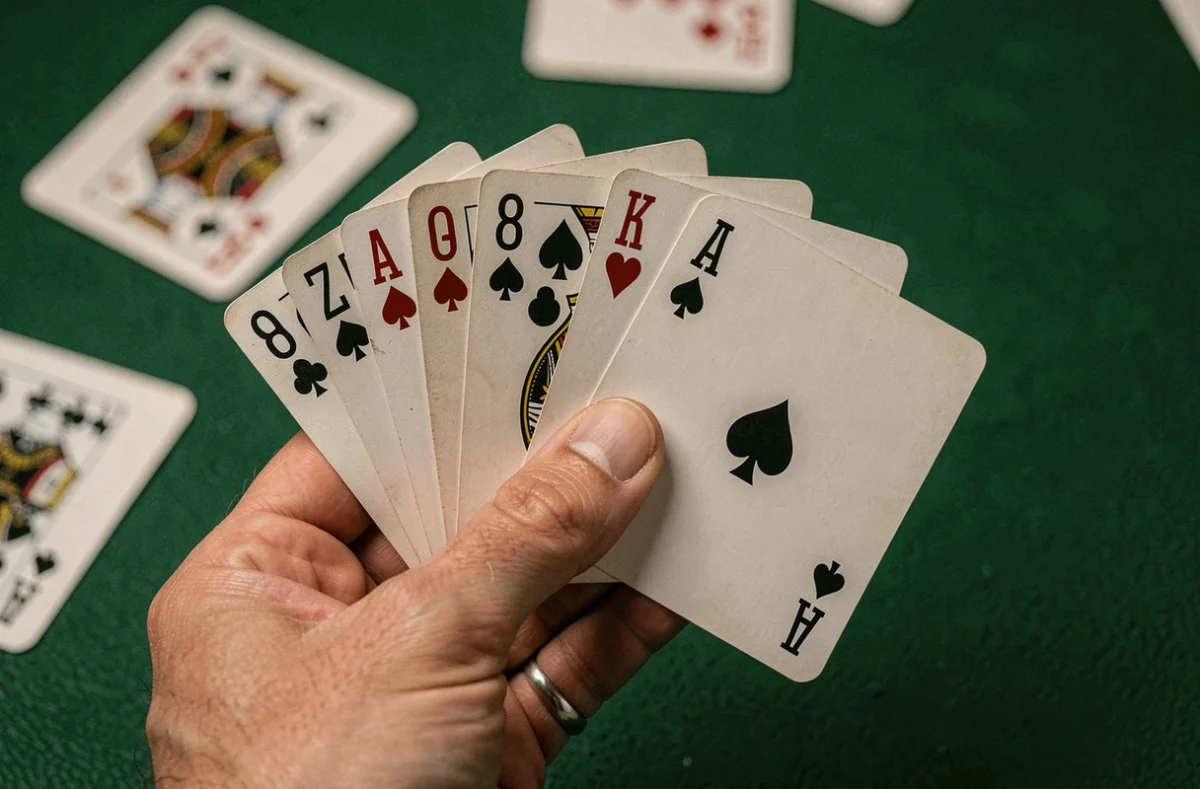
The 8 is often described as a card to hold on to for as long as possible, since it lets you change the required suit at any time. This advice makes sense in a pure shedding game, where the only goal is to empty your hand first.
In point-based games, however, where the cards left in your hand are counted, an 8 is worth 50 points if an opponent goes out before you. Keeping it for several turns means betting on your own victory, with a high penalty risk if you lose. Whether to hold or play an 8 therefore depends entirely on the format chosen by the table.
To explore this tactical aspect further, mastering American 8 means knowing exactly which scoring system is being used before each game.
| Situation | Game without scoring (pure shedding) | Point-based game (cumulative total) |
|---|---|---|
| Keeping an 8 at the end of a round | Low risk, no penalty | 50-point penalty if an opponent goes out |
| Playing the 8 early | Lose a tactical wild card | Reduces the risk of a penalty |
| Keeping an Ace or a King | Neutral | Moderate penalty (10 to 15 points, depending on the variation) |
American 8 strategies by number of players
The number of players changes the usefulness of certain special cards. In a two-player game, the “reverse” card has no effect in most variations, since play already alternates between the same two people. Holding on to it in the hope of disrupting your opponent is therefore pointless.
With four or five players, skip cards (“miss a turn”) and forced-draw cards take on a more strategic role. Targeting the player with the fewest cards in hand becomes a priority. With more players, the draw pile also runs out faster, making it more important to manage your remaining cards as the round draws to a close.
Reading your opponents’ draws
A player who draws instead of playing a card gives you a clue about which suits and ranks they’re missing. Some guides present this as a reliable technique. In practice, this deduction only holds if the table prohibits players from drawing voluntarily.
Under rules that let a player choose to draw even when they have a playable card (to keep a combination, for example), drawing reveals nothing for certain. Check this rule before basing an observation strategy on your opponents’ draws.
House rules for American 8: what really changes the game
Variations are more than cosmetic tweaks. They change the hierarchy of the cards, the pace of play, and the decisions players must make on each turn. Here are the rules that have the greatest impact on strategy:
- The number of cards dealt (7 or 8, depending on the version) shortens or lengthens the round, changing when you should start optimizing your hand
- Special effects assigned to cards (2 forces a draw, Jack skips a turn, Ace reverses direction) vary from table to table, making some general advice obsolete
- The draw rule (one card only or draw until you can play) radically changes the pace: drawing until you find a playable card speeds up the end of the game and penalizes passive players
- The point-based game’s end threshold (often set at 500) determines whether risk management matters more than shedding cards quickly
Before starting the first round, writing down the agreed special-card effects prevents most disputes. Disagreements in American 8 rarely stem from misunderstanding the basic principle (play a card of the same suit or rank); they almost always come down to uncertainty about special cards.

Special cards in American 8: a comparison of common variations
The table below summarizes the effects most commonly assigned to special cards. None of these effects is official, which explains why two players may have learned different rules in good faith.
| Card | Common effect (variation A) | Alternative effect (variation B) |
|---|---|---|
| 2 | The next player draws 2 cards | No special effect |
| 8 | Changes the required suit | Changes the suit (the same in almost all versions) |
| Jack | The next player misses a turn | No special effect |
| Ace | Reverses the direction of play | The player takes another turn |
| Joker | The next player draws 4 cards | Not included in the deck |
The 8 is the only card whose effect stays consistent from one variation to another. All other special cards change function depending on the table, so any strategic advice about them is conditional.
Mandatory announcement when you have one card left
In most variations, a player with only one card left must announce it (often by saying “card” or “last card”). Forgetting to do so usually results in a draw penalty. Borrowed from Uno, this rule does not appear in every version of American 8. Once again, checking in advance helps avoid disputes.
American 8 has endured thanks to its flexibility. Agreeing on the rules before the game matters more than memorizing a list of generic tips. A group that clearly settles its variations, scoring system, and special-card effects plays faster, argues less, and develops strategies that genuinely suit its own version of the game.